

The Challenge With Living Room Clutter
The living room earns its clutter honestly. It's where remote controls accumulate, throw blankets escape their baskets, board games get stacked on side tables, and charging cables trail across surfaces. Unlike a home office or kitchen - spaces where function clearly dictates layout - the living room is expected to be both comfortable and presentable, often at the same time.
The solution isn't to minimize what you own. It's to choose storage that disguises itself as décor. When done well, a well-organized living room doesn't look organized - it simply looks calm. This guide walks through practical approaches, from furniture choices to wall-built solutions, that give clutter somewhere to go without announcing that it's hiding.
For a broader look at how storage fits into every room in your home, see Room-by-Room Storage: A Complete Home Organisation Framework. And if you're weighing open versus concealed shelving for your space, Open Shelving vs. Closed Storage breaks down the real trade-offs.
Lift-Top and Storage Ottomans as Coffee Tables
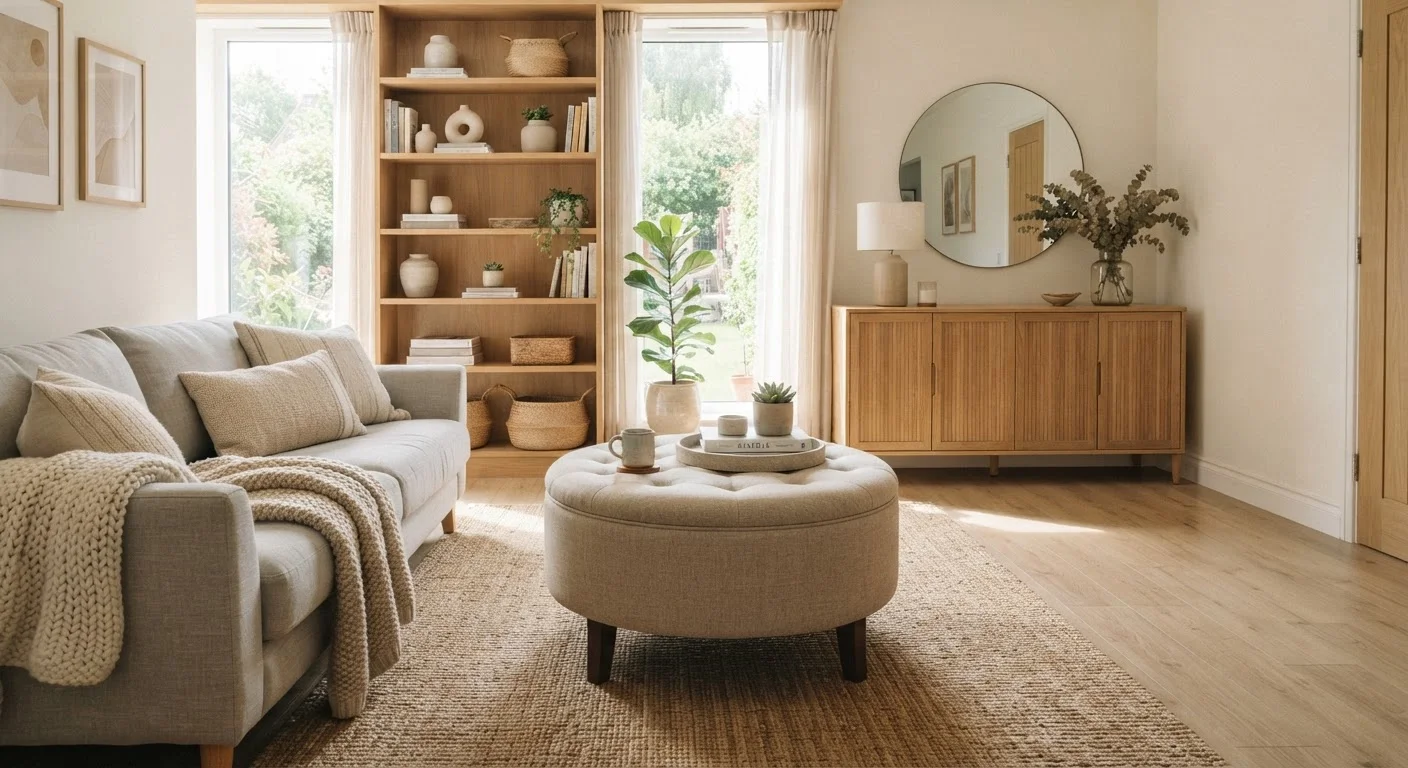
An ottoman with interior storage - especially a lift-top model - functions as a coffee table, footrest, and concealed cabinet simultaneously. The flat top provides a surface for trays and books, while the interior swallows blankets, board games, kids' toys, and anything else that migrates to the living room floor.
Choose an upholstered finish that complements your sofa, and the piece reads as furniture first. Rectangular shapes maximize surface area; round ottomans work well in tighter seating arrangements. A tray placed on top keeps drinks and remotes corralled, so the surface stays styled even on busy evenings.
An ottoman with a lift-top hides an entire basket's worth of clutter inside a piece that reads as furniture.
Sideboards and Low Credenzas Along Walls
A sideboard - sometimes called a credenza - runs low and wide against a wall, providing a generous surface for lamps or art while closed cabinet doors conceal everything beneath. Inside, the storage is generous enough for extra linens, media accessories, board games, or seasonal items that don't belong in another room.
Because the silhouette is horizontal and the front is closed, a sideboard doesn't visually interrupt the room the way a tall bookshelf might. Placing one behind a sofa (used as a console) or beneath a television makes it feel deliberately placed rather than functionally necessary.
Sideboards deliver the storage of a cabinet with the visual footprint of a long, low shelf.
Alcove Shelving With Closed Lower Cabinets
Most living rooms have at least one alcove - the recessed spaces flanking a chimney breast are the most common. These are ideal for built-in or freestanding shelving units that combine open upper shelves with closed lower cabinets. The upper portion displays books, plants, and objects; the lower cabinets absorb everything you don't want on show.
This approach doesn't require a contractor for every situation. Freestanding shelf units designed to fit alcoves, combined with cabinet-style bases, can achieve a similar look. Painting the shelving the same color as the walls is a well-known trick for making modular units look intentionally built-in.
Painting freestanding alcove shelves to match the wall color is one of the simplest ways to achieve a built-in look.
Baskets and Lidded Bins on Lower Shelf Levels
Open shelving doesn't have to mean visible clutter. Dedicating the lower two shelves of any bookcase or wall unit to lidded baskets or fabric bins creates the texture and warmth of open storage while keeping contents hidden. The upper shelves remain for curated, decorative display.
The key is consistency: matching baskets in the same material and color family - woven seagrass, felt, linen - read as a design choice rather than a containment measure. If you want to DIY coordinated containers, fabric-wrapped storage boxes are a low-cost option that lets you match any color palette.
Matching baskets on lower shelves look like a styling choice, not a clutter-management fix.
Sofa Tables and Narrow Console Shelving
A narrow console table placed behind a floating sofa - or flush against a wall if space is tight - offers a surface plus lower shelf for storage without projecting far into the room. A lower shelf can hold a row of matching bins, a stack of coffee table books, or woven baskets.
This works especially well in open-plan layouts where the sofa back faces a dining or entry area. The console reads as a visual room divider while quietly storing the things that need to stay in reach during daily use.
A console behind a sofa divides open-plan space and delivers a lower shelf for everyday storage.
Window Seat Benches With Interior Storage
If your living room has a bay window or an underutilized wall run, a built-in or freestanding bench with a hinged lid introduces seating and concealed storage in the same footprint. Cushioned tops make the seating comfortable and signal that the piece is part of the room design.
Inside, the compartment is well-suited to bulkier items: extra throw blankets, board games in flat boxes, seasonal pillow covers. Because the lid is horizontal and padded, the bench never looks like a storage unit - it simply looks like a window seat.
A cushioned storage bench at a window reads as built-in seating while hiding an entire season's worth of blankets.
Media Units With Door Panels Over Open Bays
A media unit that combines open bays - useful for streaming devices, speakers, and visible cabling - with closed door panels over adjacent sections keeps the television wall from becoming a visual tangle. The closed sections absorb gaming equipment, DVD collections, stray remotes, and cable management strips.
When evaluating whether a media unit or a sideboard better suits your television setup, proportion and placement matter as much as storage volume. The Real Difference Between a Media Unit and a Sideboard covers this decision in detail.
Closed door panels on a media unit turn a technology-heavy wall into a composed focal point.
Putting It Together
The most effective living room storage systems layer approaches: a closed-front sideboard handles the high-volume, low-visibility items while curated open shelving keeps the room from feeling sealed off. Textiles and baskets soften hard furniture edges and absorb the last-minute dumps before guests arrive.
Once you have containers and furniture in place, the part most people skip is organizing the inside. Label bins, group items by how you actually use them (TV-watching accessories together, game night supplies together), and resist overfilling compartments - a stuffed ottoman is harder to close and quicker to abandon.
If you enjoy a DIY angle, Making Fabric-Wrapped Storage Boxes From Scratch is a low-cost way to create matched containers that look intentional on shelves or inside cabinets. For anyone choosing between dedicated media furniture and a sideboard, The Real Difference Between a Media Unit and a Sideboard offers a clear comparison to help you decide.
The content on this site is for informational purposes only and is not a substitute for professional advice. Always consult a qualified professional for guidance specific to your situation.