

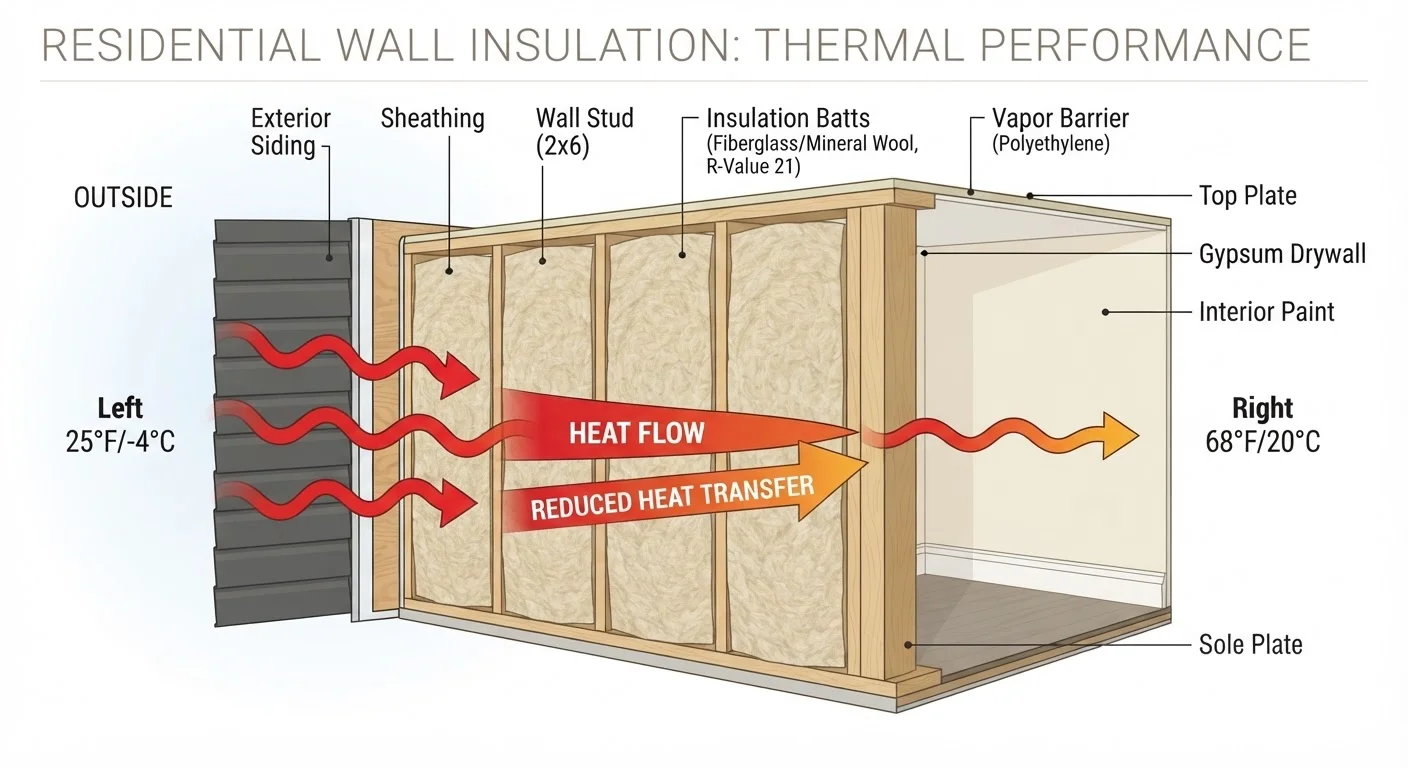
What R-Value Actually Measures
When you pick up a package of insulation at the hardware store, the R-value printed on the label tells you one specific thing: how strongly that material resists the conductive transfer of heat per inch of thickness, measured under controlled laboratory conditions. That's it - and understanding that precise scope is the key to using the number correctly.
Heat moves through building materials in three ways: conduction (direct transfer through solid material), convection (movement through air), and radiation (heat energy emitted as infrared waves). R-value specifically quantifies resistance to conductive heat flow. It doesn't capture convection through air gaps, and it doesn't address radiant heat directly - that's the job of reflective barriers, which work on a different principle entirely.
R-values are additive across layers. A wall assembly with R-13 batts plus R-5 rigid foam sheathing delivers a combined R-18 - a useful property when you're designing or upgrading a building assembly. See our guide to what each insulation layer does for a fuller picture of how those assemblies stack together.
R-49 to R-60
Recommended attic R-value in northern U.S. climate zones
According to U.S. Department of Energy guidelines for Climate Zones 5 through 8, covering much of the northern and mountain-west United States.
~40%
Heat loss attributable to air leakage in typical homes
The U.S. Department of Energy estimates that air infiltration accounts for roughly 25-40% of heating and cooling energy loss in residential buildings.
R-6 to R-7
Per-inch R-value of closed-cell spray foam
Closed-cell spray polyurethane foam consistently achieves among the highest R-values per inch of any commonly available insulation material.
Where R-Value Falls Short
The single biggest mistake DIYers make is treating the labeled R-value as a guarantee of real-world performance. It isn't. That number comes from a flat, dry, uniformly thick slab of material tested in a lab with no air movement. Your attic, wall cavity, or crawlspace is none of those things.
Three factors routinely erode effective R-value in practice:
- Compression: Fiberglass batts are rated at their full loft. Compress an R-19 batt into a 2×4 cavity (designed for R-13), and the actual thermal resistance drops - sometimes significantly. Always match batt thickness to cavity depth.
- Moisture: Wet insulation conducts heat more readily. Fiberglass batts that absorb moisture from a slow leak or condensation can lose a meaningful portion of their rated value, and the problem may not be visible.
- Air gaps and bypasses: R-value is measured under still-air conditions. An unsealed gap around a light fixture, pipe penetration, or attic hatch creates a path for warm air to move completely around insulation. This is why air sealing is typically addressed before - not after - insulation upgrades.
For a broader look at how these misconceptions trip up homeowners, common insulation assumptions worth questioning covers the most frequent errors in plain terms.
How Climate Zone Changes the Target Number
The R-value you need isn't the same in Minnesota as it is in Florida. The U.S. Department of Energy divides the country into eight climate zones, and each zone has recommended minimum R-values for attics, walls, floors, and crawlspaces. Local building codes - which often align with or exceed these recommendations - specify the legal minimums for new construction and certain renovation projects.
As a general orientation: attics in colder northern climates (Zones 5-8) typically call for R-49 to R-60, while warmer southern zones (1-3) may require R-30 to R-38. Wall assemblies typically land between R-13 and R-21 depending on framing depth and zone. These are reference points - always verify with your local building department before starting any insulation project that requires a permit.
Check Your Local Code Before You Buy
R-value minimums vary by state and municipality, and code requirements for new work or permitted renovations may differ from DOE recommendations. Pull your permit requirements before purchasing materials - you may find that your planned R-value falls short of what an inspector will accept, or that you have flexibility to downsize in warmer zones.
When comparing insulation types, R-value per inch becomes a useful secondary metric. Closed-cell spray foam delivers roughly R-6 to R-7 per inch; fiberglass batts typically run R-2.9 to R-3.8 per inch. This matters most when you're working in a space with limited depth. Comparing insulation materials side by side goes deeper on how each type performs across real installation conditions.
Using R-Value to Make Smarter Material Choices
Once you understand what the number measures - and what it doesn't - R-value becomes a genuinely useful planning tool rather than a marketing figure. Start by identifying the target R-value for your specific zone and assembly type, then work backward to determine what thickness and material combination will get you there within your available cavity space and budget.
Keep in mind that installation quality matters as much as the label. Even the highest-rated batt delivers poor results if it's installed with voids, compressed at edges, or left without air sealing at penetrations. For complex assemblies or any work involving electrical wiring, vapor barriers in cold climates, or structural modifications, consulting a building professional or certified energy auditor is a sound step - some of this work is permitted and inspected in many jurisdictions.
For a deeper look at how R-value interacts with whole-house energy performance, R-value in the context of climate zones and heat loss lays out the full framework. R-value is one of the clearest, most standardized numbers in building science - the key is knowing its boundaries so you can rely on it accurately.
Frequently Asked Questions
Higher R-value means more thermal resistance, which is generally desirable - but there are practical limits. At a certain point, adding more insulation yields diminishing returns in energy savings. The right R-value depends on your climate zone, the specific building assembly, and your budget.
Some insulation types, particularly spray foam with blowing agents, can experience slight R-value drift as gases escape the cells over time. Fiberglass and mineral wool are more stable. Moisture damage can permanently reduce the R-value of most insulation materials.
No. R-value is measured under still-air laboratory conditions and does not reflect air infiltration. Gaps, penetrations, and unsealed edges allow warm or cool air to bypass insulation entirely, drastically reducing its effective performance regardless of the rated R-value.
Yes - R-values are additive. Two layers of R-15 batts in a wall assembly combine to R-30, provided neither layer is compressed. This is a common strategy in attics where multiple batt layers or blown-in insulation are installed on top of existing material.
The U.S. Department of Energy publishes R-value recommendations by climate zone (Zones 1-8), broken down by attic, wall, floor, and crawlspace. Your local building department can confirm which zone applies to your area and what your code requires.
The content on this site is for informational purposes only and is not a substitute for professional advice. Always consult a qualified professional for guidance specific to your situation.