

Start here
What Is a Heat Pump and How Does It Work?
Next
Types of Heat Pumps You'll Encounter
Then
When a Heat Pump Makes Sense for Your Home
Going deeper
What Installation Actually Involves
Ongoing
Keeping Your Heat Pump Running Efficiently
What Is a Heat Pump and How Does It Work?
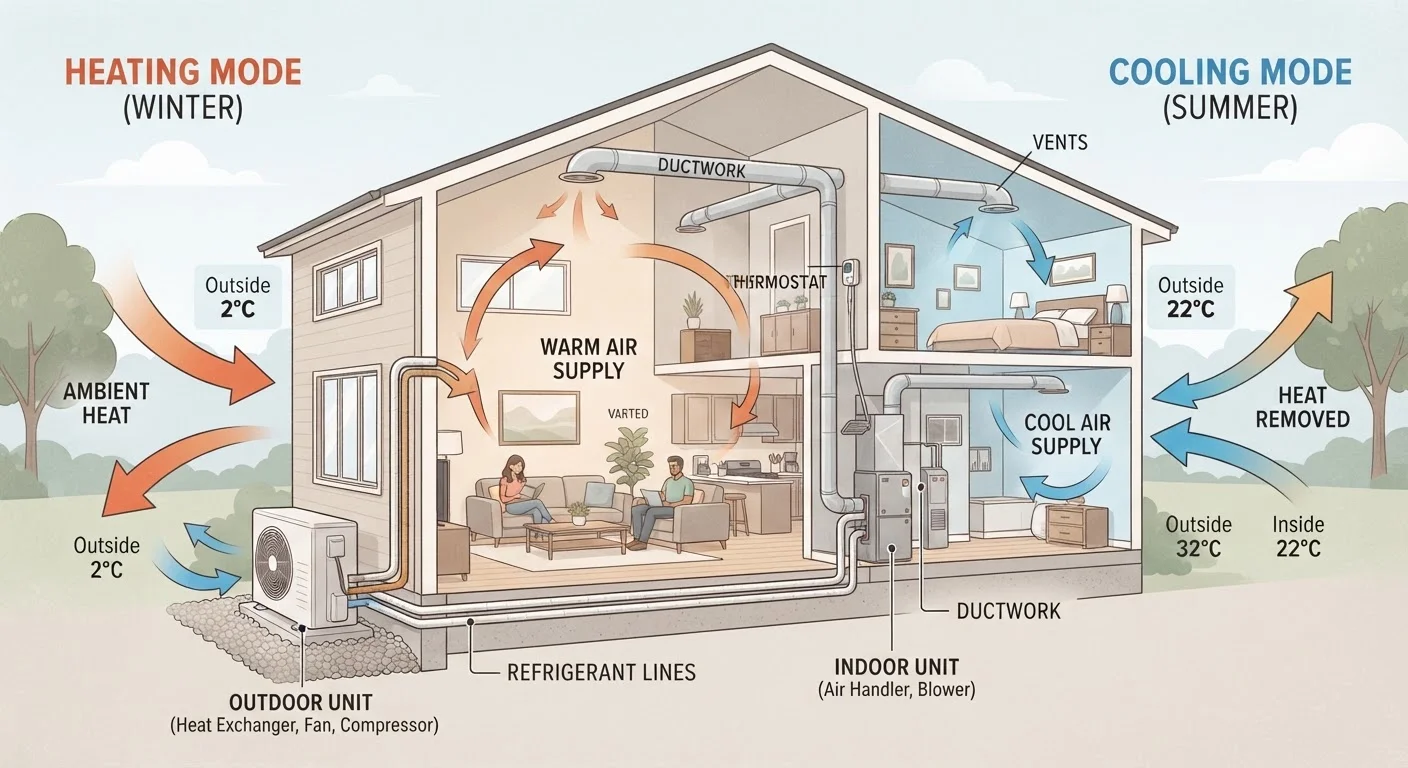
A heat pump doesn't generate heat - it moves it. That's the key insight that makes these systems so efficient. Using refrigerant and a compressor (the same basic technology in your refrigerator), a heat pump pulls heat energy out of one place and deposits it in another.
In winter, it extracts heat from outdoor air - yes, even cold air contains usable heat energy - and transfers it inside your home. In summer, it runs the cycle in reverse, pulling heat out of your indoor air and releasing it outside, exactly like a central air conditioner. One system, two seasons.
Because the system is moving heat rather than burning a fuel to create it, it can deliver more energy as heating or cooling than it consumes as electricity. This ratio is measured by the Coefficient of Performance (COP): a COP of 3 means you get three units of heating for every one unit of electricity used. That efficiency advantage is why heat pumps are increasingly central to home energy strategies. To understand how heat pumps fit alongside water heating and lighting in your home's overall energy picture, see Your Home's Three Biggest Energy Systems Explained.
Heat pump
A device that moves heat from one location to another using refrigerant and a compressor, rather than burning fuel to generate heat.
Coefficient of Performance (COP)
A measure of how efficiently a heat pump operates - specifically, how many units of heating or cooling energy it delivers for each unit of electricity it consumes.
Mini-split
A ductless heat pump system with a separate outdoor compressor and one or more indoor air handlers, connected by refrigerant lines through a small wall opening.
HSPF2
Heating Seasonal Performance Factor 2 - a standardized rating for how efficiently a heat pump heats over an entire season. Higher numbers indicate better heating efficiency.
SEER2
Seasonal Energy Efficiency Ratio 2 - a standardized rating for cooling efficiency over a full season. Higher SEER2 means lower electricity use for the same cooling output.
Load calculation
A technical assessment performed by an HVAC professional to determine the correct system size for a specific home based on square footage, insulation, climate, and other factors.
Refrigerant
A chemical fluid that circulates inside a heat pump, absorbing and releasing heat as it changes between liquid and gas states. Handling refrigerant requires EPA certification.
Types of Heat Pumps You'll Encounter
Not all heat pumps are built the same way. The most common types you'll come across as a homeowner are:
- Air-source heat pumps (ducted): These connect to your existing forced-air duct system and replace or supplement a furnace and central AC. They're the most common whole-home option.
- Ductless mini-splits: An outdoor compressor unit connects to one or more indoor air handlers mounted on walls or ceilings - no ductwork needed. Each zone can be controlled independently, which is helpful for additions, older homes, or rooms that are consistently too hot or too cold.
- Cold-climate heat pumps: A category of air-source heat pumps engineered to maintain efficiency at very low outdoor temperatures. Important if you live in a colder region of the U.S.
- Ground-source (geothermal) heat pumps: These use the stable temperature of the earth a few feet below the surface rather than outdoor air. They're highly efficient but require significant excavation or drilling, making installation more complex and costly.
For most first-timers, an air-source system - ducted or ductless depending on your home - is the practical starting point.
When a Heat Pump Makes Sense for Your Home
A heat pump tends to be a strong fit when one or more of these conditions apply:
- You're replacing an aging air conditioner and want to add or improve heating at the same time.
- Your home currently relies on electric resistance heating (baseboard heaters, electric furnaces), which is costly to run. A heat pump is typically far more efficient.
- You have a room addition, garage conversion, or zone that lacks adequate heating and cooling.
- You want to reduce reliance on fossil fuels without sacrificing comfort.
Heat pumps are less cost-effective when your home is poorly insulated or has significant air leaks, because conditioned air escapes before it does its job. Sealing and insulating first maximizes whatever system you install. Our home insulation primer is a good place to start if you're not sure where your home stands. You can also browse broader strategies at the Home Insulation hub.
It's also worth understanding how your thermostat interacts with the system. Heat pumps heat gradually and consistently - cranking the thermostat doesn't speed up the process. Why turning up the thermostat doesn't heat your home faster explains this dynamic clearly.
Insulate Before You Upgrade
Installing a heat pump in a leaky, under-insulated home is like buying a high-efficiency car with a hole in the fuel tank. Address air sealing and insulation first - even modest improvements reduce the size of system you need and lower your long-term energy bills. A smaller, correctly sized heat pump also tends to run quieter and last longer.
What Installation Actually Involves
Heat pump installation is not a DIY project. It involves electrical work, refrigerant handling (which requires EPA certification in the U.S.), and often structural modifications. A licensed HVAC contractor must do this work, and most jurisdictions require a building permit.
Here's what to expect from the process:
- Home assessment: A qualified contractor performs a load calculation to determine the right system size for your home's square footage, insulation level, climate zone, and window area. Oversized or undersized units both cause problems.
- Equipment selection: Based on the assessment, you'll discuss system type, capacity, and efficiency ratings (look for HSPF2 for heating and SEER2 for cooling).
- Installation day: For a ducted system, the outdoor unit is placed on a pad near the home, refrigerant lines are run, and the air handler is connected to existing ducts. A mini-split also requires mounting indoor heads and running lines through a small wall penetration.
- Electrical upgrade: Heat pumps typically require a dedicated 240V circuit. Your electrical panel may need an upgrade - another reason this work must be permitted and inspected.
- Inspection and commissioning: After installation, the system is tested and balanced. A building inspector verifies the work meets local code.
Get at least two or three quotes, and ask each contractor to walk you through their load calculation methodology. See the complete home energy efficiency walkthrough for context on how this fits your broader upgrade plan.
Keeping Your Heat Pump Running Efficiently
Once installed, a heat pump rewards regular, simple maintenance. Neglect is the most common reason systems underperform.
- Filter changes: Check filters monthly and replace them every one to three months depending on your household. Clogged filters restrict airflow and reduce efficiency significantly.
- Outdoor unit clearance: Keep the outdoor unit free of leaves, dirt, and debris. Maintain at least a foot of clearance around it. In winter, gently clear ice buildup - the system has a defrost cycle, but heavy ice accumulation is worth checking.
- Indoor coil and air handler: Have an HVAC technician inspect and clean the coils annually. Dirty coils reduce heat transfer and make the system work harder.
- Thermostat settings: A programmable or smart thermostat helps, but avoid large temperature setbacks with heat pumps. Unlike furnaces, heat pumps recover slowly from big temperature drops, which can trigger less-efficient backup heat.
For a full seasonal checklist covering filters, coils, and professional tune-up timing, see Seasonal HVAC Maintenance Every Homeowner Should Know.
This article is for general informational purposes only. Heat pump installation involves licensed electrical and refrigerant work and must comply with local building codes. Always consult a licensed HVAC professional and verify permit requirements with your local building department before beginning any installation.
Frequently Asked Questions
Yes - a heat pump handles both heating and cooling in a single system. In heating mode it extracts warmth from outdoor air and moves it inside; in cooling mode it reverses the process. Many homeowners use a heat pump as their primary system with a backup heat source for extreme cold.
Modern cold-climate heat pumps are engineered to extract usable heat even when outdoor temperatures drop to -15°F or lower. Older models lost efficiency rapidly in the cold, but current technology has largely closed that gap. Check the rated low-temperature performance of any unit you're evaluating.
Installation costs vary widely based on system type, home size, existing ductwork, and local labor rates. A ductless mini-split for one zone is generally less expensive than a whole-home ducted system. Get multiple quotes from licensed HVAC contractors and ask about available federal or utility rebates.
COP stands for Coefficient of Performance - it measures how much heating or cooling output a system delivers per unit of electricity consumed. A COP of 3 means the system delivers three units of heat energy for every one unit of electrical energy used. Higher COP means lower operating costs.
In most U.S. jurisdictions, installing a heat pump requires a building permit and must be performed by a licensed HVAC contractor. Requirements vary by state and municipality, so verify with your local building department before any work begins.
Air-source ducted heat pumps can use existing duct systems, but the ducts should be inspected for leaks and proper sizing first. Leaky or undersized ducts reduce efficiency significantly. If your home has no ducts, a ductless mini-split system is designed for exactly that situation.
The content on this site is for informational purposes only and is not a substitute for professional advice. Always consult a qualified professional for guidance specific to your situation.