

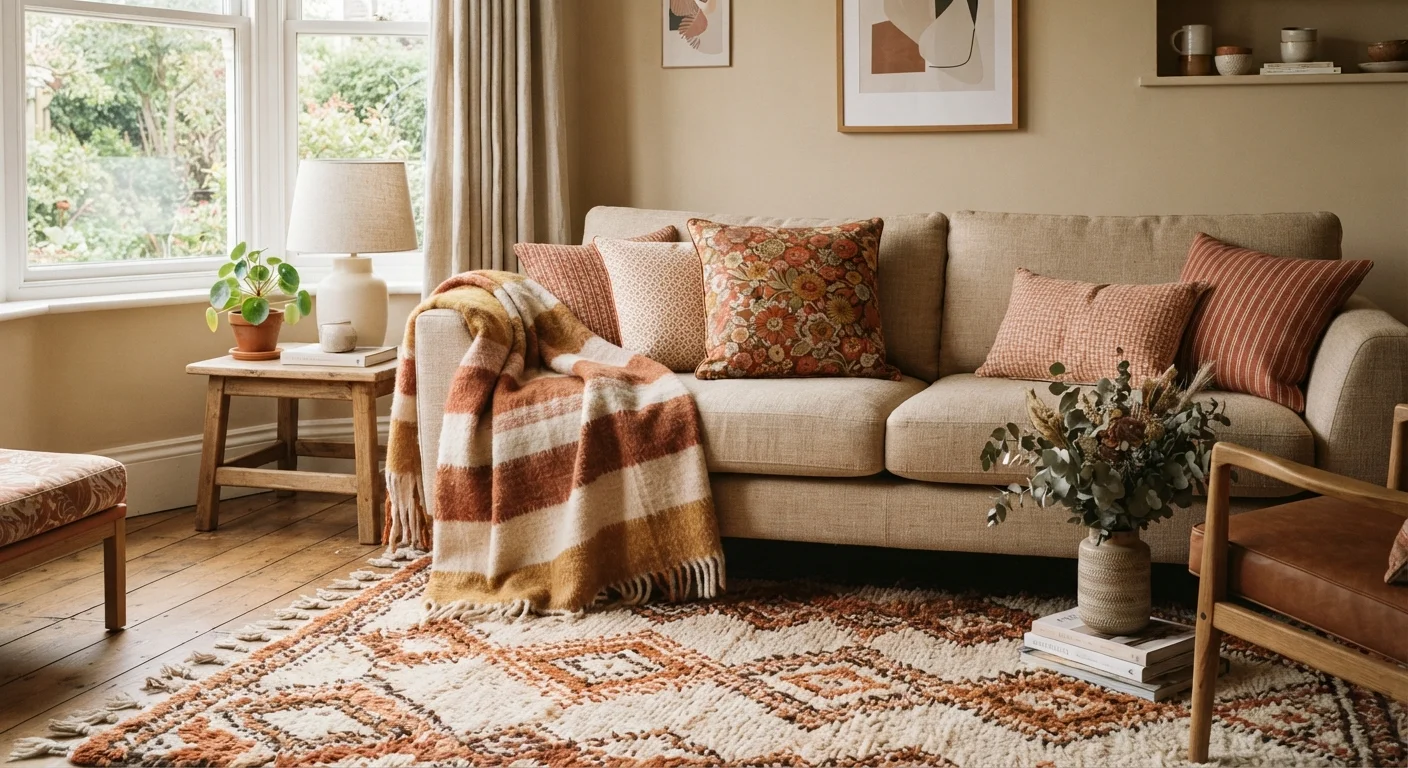
Why Pattern Mixing Feels Scary - and Why It Doesn't Have to Be
Most decorating anxiety around pattern mixing comes from one misconception: that there are rigid rules you might accidentally break. In reality, layering prints is a learnable skill built on a handful of consistent principles - not an innate gift reserved for designers with expensive educations.
The rooms that feel effortlessly layered aren't accidental. They follow a quiet logic involving scale contrast, color harmony, and hierarchy. Once you understand that logic, what looks like bold creative risk is actually methodical and repeatable. Check out the Room Styling Tips hub for a broader look at how individual techniques build on each other.
The framework below breaks down that logic into practical, actionable steps - so you can mix stripes, florals, and geometrics with confidence, not chaos.
The Core Framework: Scale, Color, and Hierarchy
Three variables do most of the heavy lifting in successful pattern mixing:
- Scale: Pair patterns of different sizes - a large-scale floral with a medium stripe and a small geometric. When all prints are the same scale, they compete for attention and the room reads as busy rather than layered.
- Color: Limit your palette to two or three colors shared across all patterns. The prints can look completely different in motif and style, but a common color thread unifies them. If you need help building that palette from scratch, pulling a palette from a patterned piece you already own is an excellent starting point.
- Hierarchy: Assign one pattern the role of anchor - typically the largest, most dominant print on your rug, sofa, or drapes. Supporting patterns exist to complement it, not rival it.
Think of it like a conversation: one voice leads, others respond. The result is layered depth, not noise.
Solids and Texture: Your Secret Stabilizers
Even a beautifully curated mix of three patterns benefits from relief. Solid-colored pillows, plain linen drapes, or a textured knit throw give the eye somewhere to rest - which paradoxically makes the patterned pieces feel bolder and more intentional.
This is closely tied to the principle of texture layering. For a deeper look at how texture and pattern interact, our guide on layering textures for cosy rooms covers the complementary technique in detail.
Rugs are a particularly powerful stabilizer. A solid-toned or subtly textured rug can anchor a mix of printed cushions and curtains without adding another competing motif. Learn more about anchoring a room with rugs to see how placement and scale affect the whole composition.
Combining Pattern Styles: Organic vs. Geometric
One of the most reliable mixing strategies is pairing organic patterns (florals, botanicals, abstract brushstroke prints) with structured geometric ones (stripes, checks, lattice). The contrast between freeform and rigid creates a pleasing visual tension - each style makes the other look more deliberate.
Stripes deserve a special mention: they function almost like a neutral in pattern mixing. A classic stripe in a muted color can bridge a large floral and a small check without drawing too much attention to itself. That utility makes stripes one of the most versatile tools in the layered-print toolkit.
If your instinct is to keep things quieter, that's a valid aesthetic too - unexpected ways designers use pattern in understated interiors explores how tone-on-tone and architectural prints add interest without volume.
For color guidance that supports your pattern choices, our room-by-room color guide helps you understand undertones and how wall color interacts with printed textiles.
The content on this site is for informational purposes only and is not a substitute for professional advice. Always consult a qualified professional for guidance specific to your situation.