

Start here
Why Container Gardening Works on Patios
Next
Choosing the Right Pot Size
Build on it
Soil Mixes That Actually Drain
Apply it
Matching Plants to Sun Exposure
Go further
Combining Plants for Visual Impact
Keep it going
Seasonal Swaps and Long-Term Care
Why Container Gardening Works on Patios
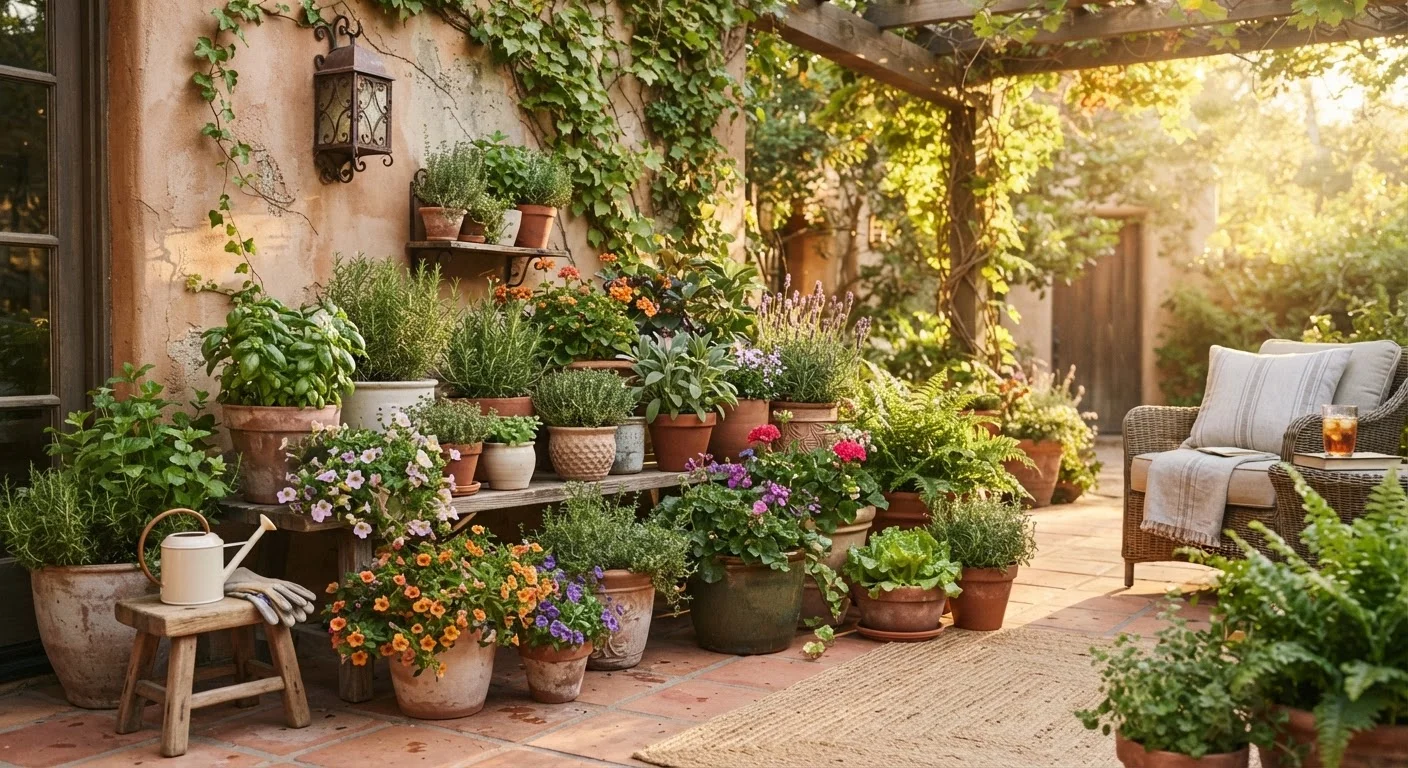
Container gardening is one of the most accessible ways to start growing plants outdoors. You control the soil, the drainage, and the location - none of which are guaranteed in an in-ground bed. For patios specifically, containers let you introduce greenery, color, and even food crops without breaking ground or committing to permanent landscaping.
Unlike starting a garden from bare ground, container growing requires no tilling, no soil amendment over large areas, and no waiting for ground conditions to improve. You can start immediately, adjust as you learn, and take your plants with you if you move. It's also a practical complement to broader gardening basics, giving beginners a low-stakes entry point with immediate, visible results.
Potting mix
A growing medium formulated specifically for containers. Unlike garden soil, it's blended to drain freely, hold some moisture, and stay loose enough for roots to grow in a confined space.
Drainage hole
An opening at the base of a pot that lets excess water escape. Without one, water accumulates at the bottom and causes root rot.
Thriller-filler-spiller
A planting formula for containers: a tall focal plant (thriller), mid-height surrounding plants (fillers), and trailing plants that cascade over the edge (spillers).
Perched water table
A zone of saturated soil that forms above a layer of coarser material in a container. Gravel at the bottom of a pot creates this effect, keeping the soil above it wetter than intended.
Cachepot
A decorative outer container used to hide a plain but functional draining pot inside. The inner pot is lifted out for watering; the outer pot stays in place for display.
Perlite
A lightweight volcanic mineral added to potting mixes to improve drainage and aeration. It looks like small white beads and prevents soil from compacting around roots.
Choosing the Right Pot Size
Pot size is the variable most beginners underestimate. A container that's too small restricts root growth, dries out within hours on a hot day, and produces weak, stressed plants. A container that's too large can hold excess moisture around young roots, inviting rot before plants establish.
As a practical starting guide:
- Herbs and small annuals: 6-8 inch diameter pots are sufficient for individual plants; a mixed herb pot works well at 12 inches.
- Tomatoes, peppers, and eggplant: Require a minimum of 5 gallons (roughly 12-14 inches diameter) - larger is better for yield.
- Shrubs and ornamental grasses: Use 15-25 gallon containers to give roots room to anchor and expand.
- Mixed flower arrangements: A 14-16 inch pot comfortably holds a three-plant thriller-filler-spiller combination.
Always check that pots have at least one drainage hole. For decorative containers without holes, use them as cachepots - place a functional draining pot inside and lift it out to water. You can explore DIY pot options too: concrete planters you can cast at home offer a creative and budget-friendly alternative.
Soil Mixes That Actually Drain
Standard garden soil does not belong in containers. In the confined environment of a pot, it compacts rapidly, reduces oxygen at the root zone, and drains so poorly that roots suffocate. A purpose-made potting mix is non-negotiable.
Look for mixes that include perlite or coarse sand for drainage, peat moss or coconut coir for moisture retention, and composted material for nutrients. For drought-tolerant plants like succulents or Mediterranean herbs, add extra perlite (roughly one part perlite to three parts potting mix) to speed drainage further.
For edible containers - vegetables and herbs - a mix with added compost boosts fertility. If you maintain a home compost system, finished compost can be blended into your potting mix at roughly 20-25% by volume. See our guide to composting at home for details on producing quality compost for this purpose.
Skip the gravel layer at the bottom
Despite common advice, adding gravel or stones to the base of a pot does not improve drainage - it actually raises the level at which water saturates the soil above it. The most effective approach is simply to use a well-draining potting mix and ensure your pot has adequate drainage holes. If water isn't moving through the pot freely, the issue is almost always the soil mix, not the absence of gravel.
Avoid the old practice of placing gravel or pot shards at the bottom of containers to improve drainage - research has shown this actually creates a perched water table that keeps the soil above it wetter, not drier. Good potting mix and adequate drainage holes are all that's needed.
Matching Plants to Sun Exposure
Before buying a single plant, observe how sunlight moves across your patio over a full day. Most patios receive a combination of direct sun, partial shade, and deep shade depending on walls, overhangs, and neighboring structures - and this determines everything about plant selection.
- Full sun (6+ hours direct sun): Tomatoes, peppers, basil, lavender, marigolds, geraniums, and most succulents thrive here.
- Part sun / part shade (3-6 hours): Ideal for impatiens, begonias, coleus, lettuce, and parsley.
- Full shade (fewer than 3 hours direct sun): Ferns, hostas, caladiums, and cast-iron plants tolerate low-light conditions.
Patio surfaces - especially concrete and tile - radiate heat, which can accelerate drying and stress heat-sensitive plants. Positioning shade-tolerant containers against walls or under a pergola can moderate temperatures. If your space needs more structure overhead, planning a pergola is worth exploring as a longer-term project.
Combining Plants for Visual Impact
The most visually satisfying containers use a three-part planting formula: thriller, filler, spiller. The thriller is a tall, upright focal plant (ornamental grass, tall salvia, or a standard-form plant). Fillers are mid-height plants that surround it - think compact zinnias, calibrachoa, or sweet potato vine. Spillers trail over the pot's edge - ivy, bacopa, and lobelia are reliable choices.
Beyond aesthetics, group plants with compatible needs. Don't pair a drought-tolerant lavender with a moisture-loving fern in the same pot - one will always be stressed. Similarly, sun-lovers and shade-plants don't coexist well even if the visual combination is appealing.
For smaller patios, container groupings in odd numbers (three or five pots of varying heights) create a more natural, designed look than a uniform row. This principle overlaps with broader design thinking covered in design principles for small outdoor spaces.
Seasonal Swaps and Long-Term Care
One of container gardening's greatest advantages is adaptability. As the growing season shifts, swap out spent plants for new ones suited to the next season's temperatures without disturbing your entire garden layout.
- Spring: Pansies, violas, snapdragons, and cool-season herbs like cilantro and dill.
- Summer: Petunias, basil, tomatoes, and heat-tolerant succulents.
- Autumn: Ornamental kale, mums, and asters carry color into cooler months.
- Winter: Evergreen branches, dwarf conifers, and cold-hardy sedums provide structure when little else grows.
Beyond planting, container maintenance involves refreshing soil annually, fertilizing regularly (potting mixes lose nutrients faster than ground soil), and checking pots for cracks before winter if you're in a freeze-prone region. For a broader seasonal checklist that covers your whole patio - not just the pots - see preparing your patio for every season.
Frequently Asked Questions
Most patio containers need watering every one to two days in summer, since pots dry out faster than garden beds. Check by pushing a finger an inch into the soil - water when it feels dry at that depth. Larger pots retain moisture longer than small ones.
Yes - drainage holes are essential for nearly all plants. Without them, water pools at the bottom, roots sit in saturated soil, and root rot follows quickly. If you love a decorative pot without holes, use it as a cachepot (outer sleeve) with a draining inner pot inside.
Garden soil is not suitable for containers. It compacts under repeated watering, restricts oxygen to roots, and drains poorly in the confined space of a pot. Use a quality potting mix formulated for containers instead.
It's a simple planting formula: a tall 'thriller' anchors the pot visually, mid-height 'fillers' surround it with texture and color, and trailing 'spillers' cascade over the pot's edge. The result is a layered, full arrangement from a single container.
Choose lightweight pot materials such as fiberglass, resin, or fabric grow bags. Fill the bottom quarter with lightweight filler like perlite, pumice, or empty plastic bottles before adding potting mix. Place heavy pots on wheeled plant caddies before filling them.
Potting mix breaks down and loses structure over one to two growing seasons. Refresh containers annually by removing spent plants, loosening old mix, and blending in fresh potting soil along with a slow-release fertilizer to restore nutrients.
The content on this site is for informational purposes only and is not a substitute for professional advice. Always consult a qualified professional for guidance specific to your situation.